SMS Opt-In & Consent
Last updated: 16 July 2026
This is Rynger’s SMS opt-in page. The working form below is the opt-in form exactly as it appears in the app — including the phone-number field and the consent checkbox (unchecked by default). It is public and login-free so carrier and campaign reviewers can verify the flow that normally sits behind our sign-in; recipients additionally confirm by replying YES before any task message is delivered (double opt-in, documented below).
Try the opt-in form (interactive demo — nothing is sent)
A functional replica of the in-app opt-in form, using the exact production wording. Type in the fields, click Review & text, check the attestation box, and click Place the text to see the consent request the recipient would receive. This is a demo for review purposes: no account, no SMS, no data leaves this page.
The account holder enters the recipient business’s number here.
Rynger texting program: conversational, transactional messages about your requested task only (appointment scheduling, reservations, questions) — never marketing. The first text asks the recipient to consent — your message is delivered only after they reply YES. Message frequency varies by task, typically 2–10 messages per conversation. Message and data rates may apply. Recipients can reply STOP to unsubscribe at any time or HELP for help.
This is the consent request the recipient receives first (the task message is delivered only after they reply YES):
Demo only — no SMS was sent. In production this request goes out, the thread waits in “awaiting consent,” and a YES (stored with number, timestamp, and the literal reply) starts the conversation. STOP blocks the number permanently. If there is no reply, nothing further is sent and the account holder is not charged.
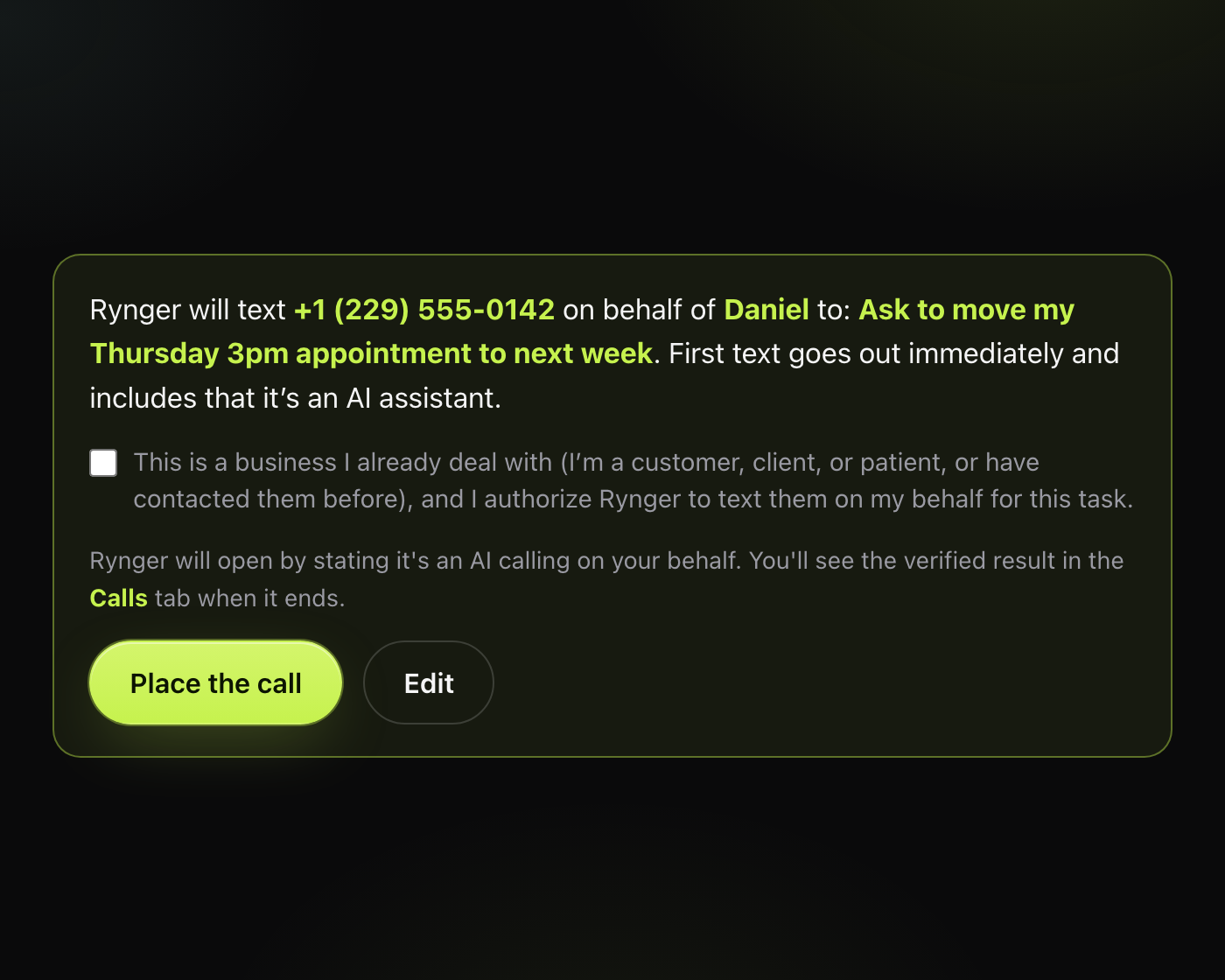
The checkbox is unchecked by default. “Place the text” is refused until it is actively checked — in the demo above and in production, where the backend independently rejects any request submitted without the attestation.
The in-app opt-in form (screenshot)
The complete text-task opt-in form as rendered by the app (sign-in required in-product; hosted here for review). It shows the phone number field (“Number to text” — where the account holder enters the recipient business’s number), the task description, the on-whose-behalf name, the review step, the attestation checkbox (unchecked by default), and the program terms (message types, frequency, “Message and data rates may apply,” STOP/HELP). Direct image link: rynger.ai/assets/sms-optin-checkbox.png.

Who sends and receives these messages
Rynger is a personal assistant. An account holder signs up at rynger.ai (agreeing to the Terms of Service and Privacy Policy), and can then ask Rynger to send SMS on their behalf to a business they already have a relationship with (their clinic, restaurant, or service provider) to carry out a specific task — scheduling, confirming, or asking a question. Messages are conversational and transactional. Rynger sends no marketing content and is not for texting personal or consumer contacts.
The opt-in flow, step by step
- Sign-up: the account holder creates an account at rynger.ai and accepts the Terms of Service and Privacy Policy.
- Task creation: in the app, the account holder describes the task, enters the business’s number, and reviews a confirmation step. Texting is only possible to numbers the account holder has previously called through Rynger, or that have texted the account holder’s dedicated Rynger number first.
- Active consent (unchecked by default): the confirmation step contains the attestation checkbox reproduced below. It is never pre-checked; the task cannot start until the account holder actively checks it. The attestation is stored with the task (timestamped and versioned) as an audit record.
- Program terms at the point of opt-in: the same confirmation step displays the message types (conversational, transactional messages about the requested task only — never marketing), the recipient consent step below, the expected message frequency (varies by task, typically 2–10 messages per conversation), “Message and data rates may apply,” and opt-out instructions (reply STOP to unsubscribe at any time, HELP for help).
- Recipient double opt-in (reply YES): the first text to any new recipient is a consent request, not the task. It identifies the sender as an AI assistant acting for the named account holder, asks the recipient to reply YES to receive the message, notes “Msg&data rates may apply,” and ends with “Reply STOP to opt out.” The task conversation starts only after the recipient replies YES; the YES is stored (number, timestamp, literal reply) as consent evidence. If the recipient never replies, nothing further is sent and the account holder is not charged.
- Opt-out: replying STOP at any point — including instead of YES — halts messaging to that number immediately and permanently blocks new tasks to it; HELP returns help information.
Sample messages
1 · The consent request (always the first message to a new recipient):
Hi, this is an AI assistant texting on behalf of Daniel Kim. Daniel Kim has a message for you. Reply YES to receive it. Msg&data rates may apply. Reply STOP to opt out.
2 · The task message (delivered only after the recipient replies YES):
Thanks! Daniel is a patient at your clinic and would like to move his Thursday 3pm appointment to next week — do you have any openings?
Program disclosures
- Recipient double opt-in: the first text asks the recipient to reply YES; the task message is delivered only after they consent. No reply → nothing further is sent.
- Message frequency varies with the account holder’s use.
- Message and data rates may apply.
- Reply STOP to cancel at any time; reply HELP for help.
- We do not sell or share mobile information, SMS opt-in data, or phone numbers with third parties or affiliates for marketing (see the Privacy Policy).
- Full texting terms: Terms of Service, “Calls, texts, recording & consent.”
Contact
Questions about this flow: hello@rynger.ai. dudok.io, a registered trade name (DBA) of Sparkvern LLC, 2104 House Ave, Cheyenne, WY 82001, USA.